NEWS
2026.07.29
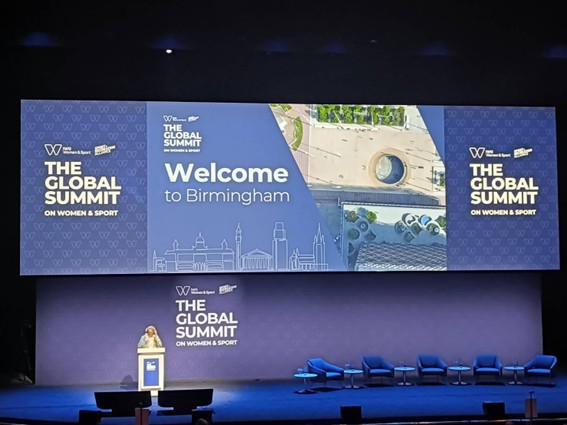
From July 9 to 11, 2026, at the 9th IWG Women & Sport Global Summit held in Birmingham, UK, Aya Noguchi, Associate Professor in the Faculty of Arts and Letters and Deputy Director of the International Research Center for Sport and Gender Equality (SGE) at Seijo University, gave a presentation titled "Mainstreaming Gender in ASEAN Sports Policies through the ASEAN-Japan Actions on Sport: Gender Equality Project."The presentation was delivered in the "Insight Stage" format, where speakers shared knowledge gained from practical implementation under the key theme of "Innovation."
About the IWG Women & Sport Global Summit
The IWG Women & Sport Global Summit is the world's largest international conference focused on gender equality in sports and physical activity.
The 9th edition took place from July 9 to 11, 2026, in Birmingham, UK, bringing together over 1,200 participants from around the world, including sports officials, policymakers, researchers, practitioners, and athletes.
The summit discussed research outcomes, practical examples, and policy challenges aiming to improve the sports environment surrounding women and girls under five main themes: "Investment," "Leadership," "Innovation," "Visibility," and "Participation." Associate Professor Noguchi presented on the Insight Stage established under the "Innovation" category.
Presentation Contents
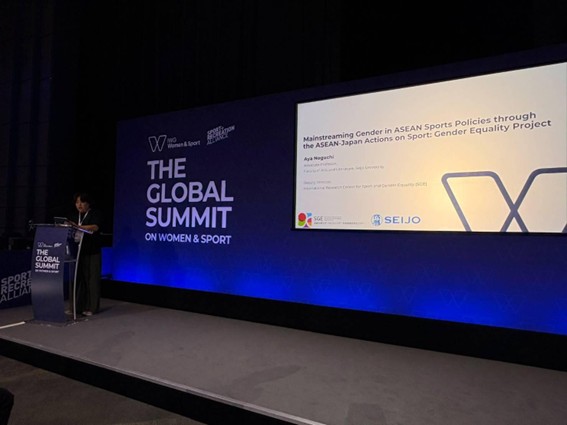
The presentation reported on the details and outcomes achieved to date of the "ASEAN-Japan Actions on Sport: Gender Equality" project, which is commissioned by the Japan Sports Agency and implemented by the Seijo University International Research Center for Sport and Gender Equality
This project aims to incorporate a gender perspective into the sports policies of various countries through cooperation between Japan and ASEAN member states in the field of sports. ASEAN countries vary significantly in terms of political systems, economic conditions, cultural and religious backgrounds, and sports administration structures.
Therefore, rather than introducing a single policy model as is, the project emphasizes co-designing initiatives suitable for each country's unique situation while respecting their knowledge, experience, challenges, and ownership.
The project advances its initiatives primarily by combining the following four pillars:
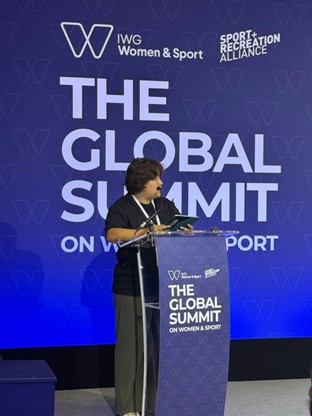
Achievements so far include explicitly positioning gender equality within ASEAN's sports work plans, creating common regional indicators, and establishing learning networks among policymakers.
Concrete changes are taking place in individual countries as well: the formulation and revision of policies related to women and gender in Brunei and Malaysia; capacity development programs targeting women in sports in Cambodia; and the clarification of policy responses regarding pregnancy and childbirth for female athletes in Vietnam.
In addition, initiatives for gender equality have commenced at the government level in Laos and Myanmar. On the Japanese side, efforts are moving toward long-term collaboration looking ahead to 2030, rather than treating it merely as a short-term project.
On the Insight Stage, alongside these individual achievements, Associate Professor Noguchi shared key insights gained from the project: namely, that creating policy changes through training alone is difficult, and that it is crucial to combine research, continuous dialogue and support, and bridging with international networks.
Conclusion
This presentation reported on the importance of combining research, training, and continuous follow-up support while respecting the diverse backgrounds and ownership of each ASEAN country.
Moving forward, it will be essential to connect formulated policies to budgets and concrete programs, as well as to foster mechanisms where countries can learn from one another within the region and sustain these initiatives.
Through this project, we will continue to collaborate with stakeholders across ASEAN countries to realize a gender-equal sports environment.